

West Coast System
This system was developed alongside its namesake scheme, and uses specific words to describe formations, blocking schemes and routes. The Spider 2 Y Banana play made famous by Jon Gruden (and that we turned into a challenge for Gary a few weeks ago) uses the ‘West Coast’ playcalling system.
Just for clarity we will use another play to describe what is going on (but remember different teams may use slight variations on this general formula when calling their plays):
FB West Right Slot 372 Y Stick
‘FB West Right Slot’ is the formation being used, ‘372’ is the blocking scheme and ‘Y Stick’ is what the primary receiver will run.
‘FB West’ indicates where the FB lines up, in this case in an offset I formation with the FB to the right, while ‘Right Slot’ indicates the side the Y receiver, most likely the TE, will line up on, with two WRs (X and Z) out wide.
‘372’ indicates the blocking scheme, with each digit indicating the responsibility of each offensive lineman. The first number refers to the tackles, who in this case will slide block the B gap; the second number refers to the guards, who will pull and block the D gap, outside the original spot of the tackle, close to the TE position; and the third number refers to the center, who will block the strong side A gap (if this number was 1 he would block the weakside A gap). Strong and weak side will determine where the FB, TE or most WR are on the side of the field.
‘Y Stick’, this is the route for the primary receiver: a 3-5-yard hitch route. The QB will use hand signals to indicate routes to the other three receivers (2 WR and HB) when positioned, once he has a better understanding of what the defence is showing him.

Coryell System
Like the West Coast system with its namesake scheme, this system was developed in tandem with the Air Coryell scheme. It is based on a system of numbers to refer to the receiving routes on pass plays and the target of a run on rushing plays, as it is the easiest method to remember. The play call informs the formation, blocking and routes, mostly in numbers, and like the West Coast system, different teams may use slight variations on this in their playcalling.
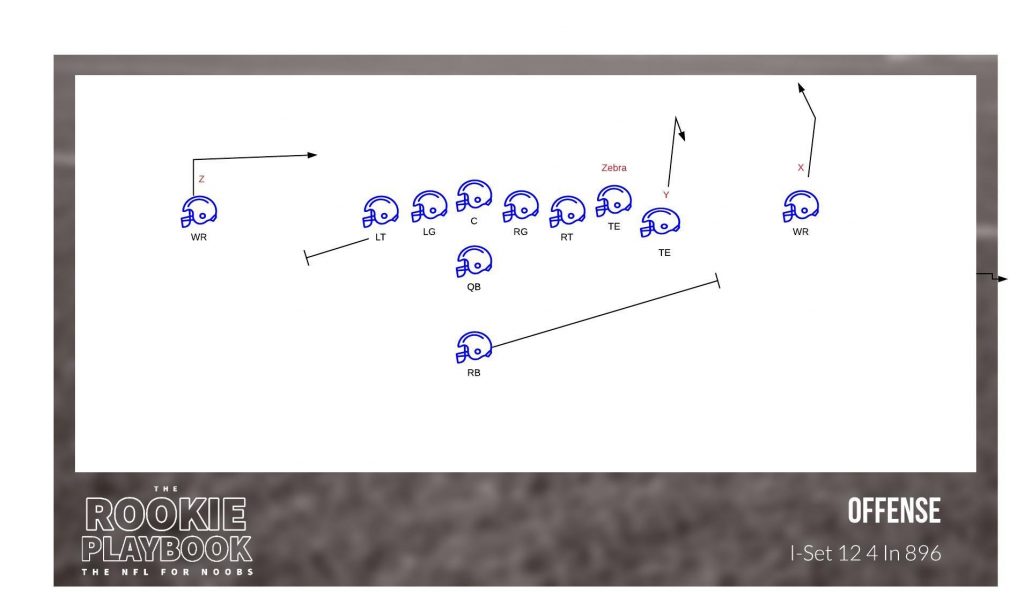
“I-Set 12 4 In 896”
Again, formation would be said first, ‘I-Set’, ‘4 In’ is the blocking scheme and ‘896’ is the route tree.
‘I-Set 12’ – I formation, with 1 RB and 2 TE and 2 WR.
‘4 In’ – four of the OL will block in, the LT will slide block for blindside protection and the RB will block the right side or any oncomers upfront. The TE closest to the OL will block, unless he has no-one to block then he will run a flat.
‘896’ – These numbers indicate the routes of the three main receivers (X, Y and Z). The first number is the X receiver’s route, in this case an 8 or ‘post’ route; the second number is for the Y receiver, who would run a ‘curl’ route; and the third number is for the Z receiver, who would run an ‘in’ route.
Erhardt-Perkins System
This system was developed by two assistant coaches of the New England Patriots in the 1970s. It is based on a single-word concept rather than a specific code for each individual player. The emphasis is heavy on memorisation for every player, as each player will have to know the roles of every player on the team, not just their own.
“Ghost”
This will tell the formation, blocking and route for the whole team regardless of personnel.
This style of system is used by every single team in the NFL in one form or another, predominantly on no-huddle or hurry-up offense. If the team had less than 2 minutes left in the game and needed to play quick, the coach would send in four plays to the QB so he could pass on in the first and hopefully only huddle of that series. These plays would be linked to hand signals as well so the quarterback can silently remind his team what the next play is.
“Ghost, November, India, Columbus”
2 Pingbacks